Check It Out
by Andrew Seale
photography by Chris Robinson
Step back from the hazard tape. Jacob Turola points to the streaks of black and yellow lines marking out a corner of his carefully assembled universe on the third floor at York University’s Markham Campus. On the counter, futuristic-looking jet-black and lime-green tents conceal a pair of 3D resin printers. “It looks super sketchy,” Turola says, flashing a grin. “It’s not that bad for you, but the more you get exposed to resin, the more allergic you become … Also, it’s a volatile organic compound, so, not that good for you.”
This isn’t some hidden science lab or start-up office. It’s a “makerspace” – a hands-on studio within the University library, where books aren’t the only thing on loan. Students experiment with 3D printing, laser engraving, circuitry, sewing machines and vinyl cutting. Next door is a podcast studio and green-screen room; down the hall is a studio with a wall of high-resolution screens run by the Campus’s data visualization librarian.
“It’s a place where people get access,” says Turola, the makerspace coordinator. “Come here, try it out or learn a new resume-based skill. That’s what this is for.”
Digital literacy and understanding what’s real and what’s fake – we were doing that before it was cool

Rachael Denov, a second-year entrepreneurship student, remembers the moment she first saw the makerspace: a 3D-printed whale shark caught her eye. It was enough to get her into the space, and from there, she was hooked. She’s since learned to use the laser cutter and is building an electric guitar from scratch. “I never viewed myself as someone who would be doing any building or tinkering. I’m in business, and the stereotype is that we’re not doing any of this stuff,” Denov says.
For her, the space isn’t just a workshop; it’s an open invitation to break stereotypes with tools and technology otherwise out of reach. “For a long time, our society has celebrated intellectual elitism,” Denov says. “Places like the library, and especially the makerspace, are trying to tear that idea apart.”
But keeping open access – the kind that changed Denov’s path – has become a fight for libraries. Every year, tighter budgets and political headwinds threaten what community spaces can offer. Across Ontario, libraries juggle rising costs for technology and staffing, all while defending public ground in an age of noisy misinformation.


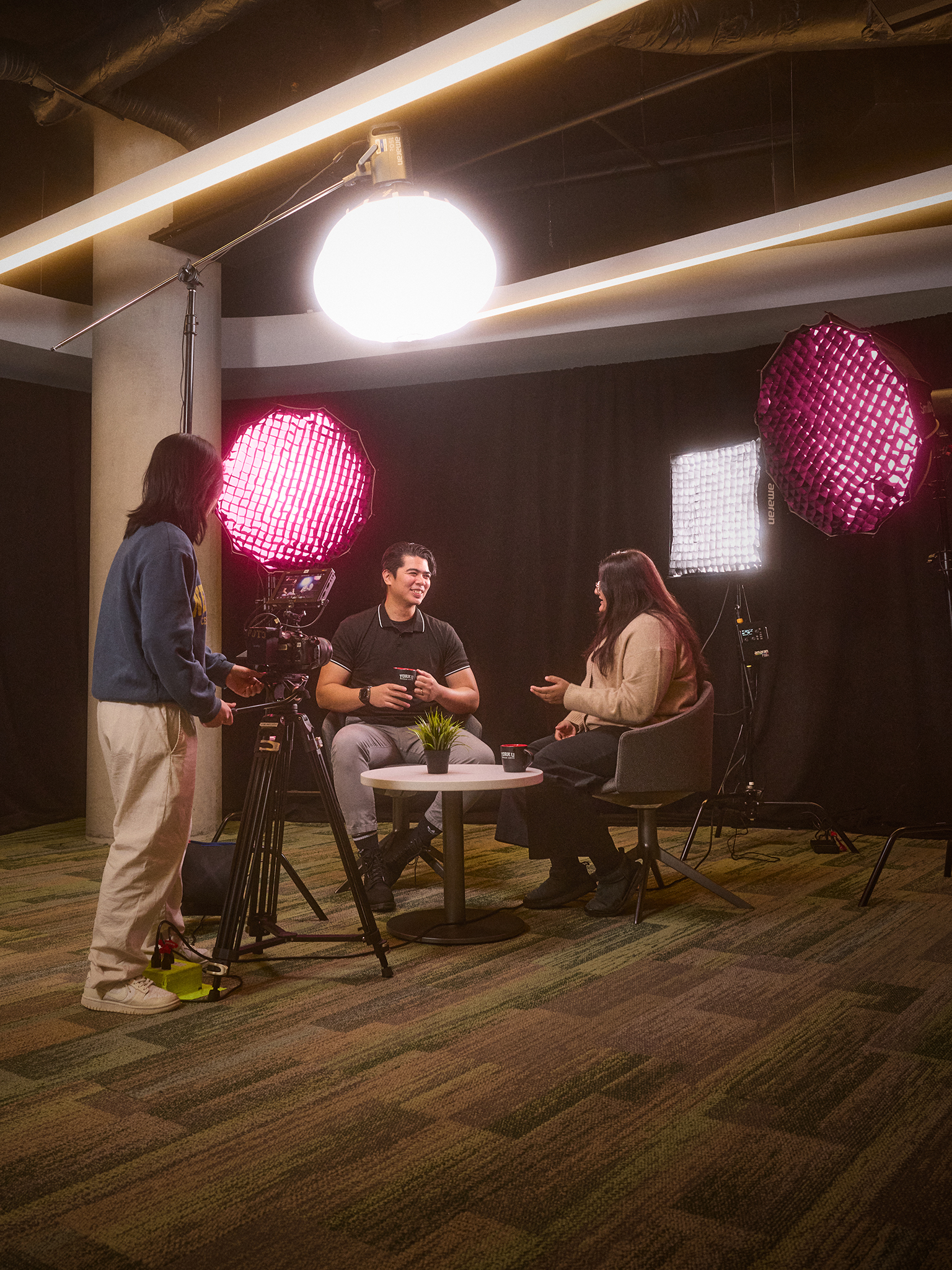
YORK’S MARKHAM MAKERSPACE hints at the future libraries are working toward – a space for collective learning and experimentation. But this model faces daunting challenges. To understand what’s at stake, look to Toronto Public Library (TPL), the country’s largest and busiest system. Its new head, Moe Hosseini-Ara (BA ’94), has stepped in just as the ground is shifting.
Hosseini-Ara is only a few months into the job, still absorbing the rhythms of a system that spans 100 branches, thousands of staff and millions of interactions a year. But he’s not new to libraries. Before entering York’s anthropology program, he started as a teenage page, shelving books long before “digital transformation” became a civic buzzword. He’s watched libraries withstand predictions of technological doom – from the CD-ROM to the rise of the internet.
“When the internet was first out, I was working as a librarian, and everyone said it was going to kill the library,” he recalls. It didn’t – it became something libraries had to teach people about. “Digital literacy and understanding what’s real and what’s fake – we were doing that before it was cool. Now, it’s what’s eroding society.”
That is a huge risk right now to the library community – people not understanding the precarity of libraries

That erosion isn’t theoretical – it turns up in Toronto’s libraries every day as they handle everything from rising inequality to mental health crises spilling through their doors.
Hosseini-Ara calls the library a “canary” – not because it’s fragile, but because it’s exposed. Libraries remain one of the last places anyone can enter freely, no fee or appointment required, no need to prove they deserve to be there.
“We’re open and welcoming to all,” he says, “and that’s also the most challenging thing about libraries.”
The Canadian Urban Institute’s “OVERDUE” report, released in 2023, put it bluntly: public libraries, once neutral civic spaces, now serve as “de facto triage centres,” stepping in when other supports falter. Toronto’s answer has been direct. In partnership with Gerstein Crisis Centre, TPL launched crisis support services across 12 branches. They’ve fielded more than 12,000 interactions in 18 months – crisis workers offering immediate help to thousands and connecting even more to wellness checks, housing and income support.
Books are still a big part of what we do. You just don’t see them

“We’re not going to kick them out. We’re going to try to serve them where they are and connect them with support,” Hosseini-Ara says. For him, this is what library work means: responding to needs as they show up and repairing the city, day by day.
That same imperative extends to digital inequity. Toronto’s branches have become coworking spaces, youth hubs and digital labs where people learn everything from robotics to artificial intelligence. “It is moving so quickly,” he says. “The role of the library is to make sure people understand how AI impacts their lives.”
This isn’t about turning libraries into miniature tech hubs. The goal is simple: ensure no one is left behind. Both at Markham Campus and across TPL, the mission is practical: close gaps in access and confidence. At Toronto Public Library, that means building AI learning cohorts with Google and running Digital Inclusion Week workshops. For Ab Velasco, TPL’s manager of innovation, it’s about creating a space for “the community to have welcoming and equitable access to information in all its forms.”
From April to September, TPL’s AI learning circles gathered more than 600 learners in 37 cohorts, logging 2,000 session visits. Participants included IT professionals, artists, teachers at every level and job seekers from every corner. “We even had elementary, high school and university-level teachers (who) participated in the learning circle,” Velasco says, adding that “everyone’s looking to build skills for what comes next.”
Libraries remain a vital refuge offering safe spaces, new digital skills and real access to knowledge and community support

But beneath the success story is a real pressure: libraries are filling gaps left by shrinking public systems – even as per capita funding stands still. The hopeful scene of strangers gathered around a table is real, but it’s also the front line for digital and social divides.
A 2024 report from the Canadian Centre for Policy Alternatives underscored how precarious TPL’s footing has become. In 2023, Toronto’s library ran on a $234.6-million budget – 91 per cent from the city, only 2.4 per cent from the province. Provincial support has dwindled; that leaves the system to stretch per capita funding, delay repairs and stall new service rollouts. Nearly $200 million in urgent infrastructure work looms over dozens of branches, even as daily demand climbs.
Michelle Arbuckle, executive director of the Ontario Library Association, sees the same struggle province-wide. “One of the biggest challenges that I face in talking with government and other stakeholders and decision-makers is getting people to understand just how fragile libraries are,” she says. “That is a huge risk right now to the library community – people not understanding the precarity of libraries.”
That sense of fragility accompanied Arbuckle to the International Federation of Library Associations summit for urban leaders, which took place in Toronto in October. The summit’s agenda focused on how libraries respond to social isolation, foster community resilience, and promote civic engagement and democratic participation. Conversations drew out a larger truth: the stakes for libraries extend far beyond books or buildings, touching on whether communities remain connected and equipped for public life. “That is also recognizing the things that are currently at threat in our world around democracy, and how the work libraries are doing is really helping to combat that and bring people together,” she says.
Hosseini-Ara was at the summit as well. Eight years prior, he had warned colleagues about book bans and threats to intellectual freedom, concerns that others at the time felt were remote. “Now, they’re seeing these issues,” he says. “It’s spread around the globe.”
Trust vanishes quietly – until the loss is unmistakable. Hosseini-Ara draws attention to the recent surge of laws and campaigns in the U.S. aimed at removing books from shelves and pressuring libraries, calling them a warning. Efforts to censor, he explains, are aimed at libraries precisely because they are relied on by the public to provide real, unrestricted information: “That is a sign that libraries are trusted,” he says. “The people who are attacking libraries recognize that that’s a bad thing for their cause, which is around misinformation, disinformation and preventing access to information.”
Evolution is mostly invisible, but all you have to do is look at a resource like the library makerspace to see how different a library can look

So this is the future for libraries: caught between precarity and underfunding, facing a tide of legislative pressures, censorship and rapid technological change. Yet the outlook isn’t all bleak. Libraries remain a vital refuge offering safe spaces, new digital skills and real access to knowledge and community support at a time when those qualities are needed more than ever.
The future for libraries also means adapting to rapid technological change. That transformation is visible at York’s Markham Campus, where almost-empty shelves reflect a shift away from print to digital collections. “Books are still a big part of what we do,” says Joseph Hafner, York’s dean of libraries. “You just don’t see them.” About 90 per cent of acquisitions are now e-books. “We’re actually able to buy more books per year,” Hafner continues. “But the way that we buy books has changed completely in the last decade or two.”
All you have to do is look at a resource like the library makerspace to see how different a library can look, how much it can evolve
Shifting to a digital-first model, the University buys in bulk through the Canadian Research Knowledge Network, then shares holdings across campus. “The days of needing to fill shelves with row after row of journals are not there,” Hafner says.
The other part of the story is that the Markham Campus itself is only two years old. “We haven’t rushed at Markham to buy a bunch of books,” Hafner explains. “We’re trying to figure out what courses are being taught there and how the students interact with the things they need.”
Evolution is mostly invisible, but all you have to do is look at a resource like the library makerspace to see how different a library can look, how much it can evolve. That’s key to the future of libraries: adaptation, an institution that shape-shifts in real time. You can see it playing out in the halls of the Markham Campus Library just as much as in TPL’s adoption of AI literacy programs and crisis prevention.
As Hosseini-Ara observes, a library is both a real place and a story we tell ourselves about what it can be.
“We have evolved and morphed over time,” he says. “We exist to better the lives of the residents and the community … and we’re going to do what we need to do within the mandate of libraries to ensure we stay relevant.” ■
